

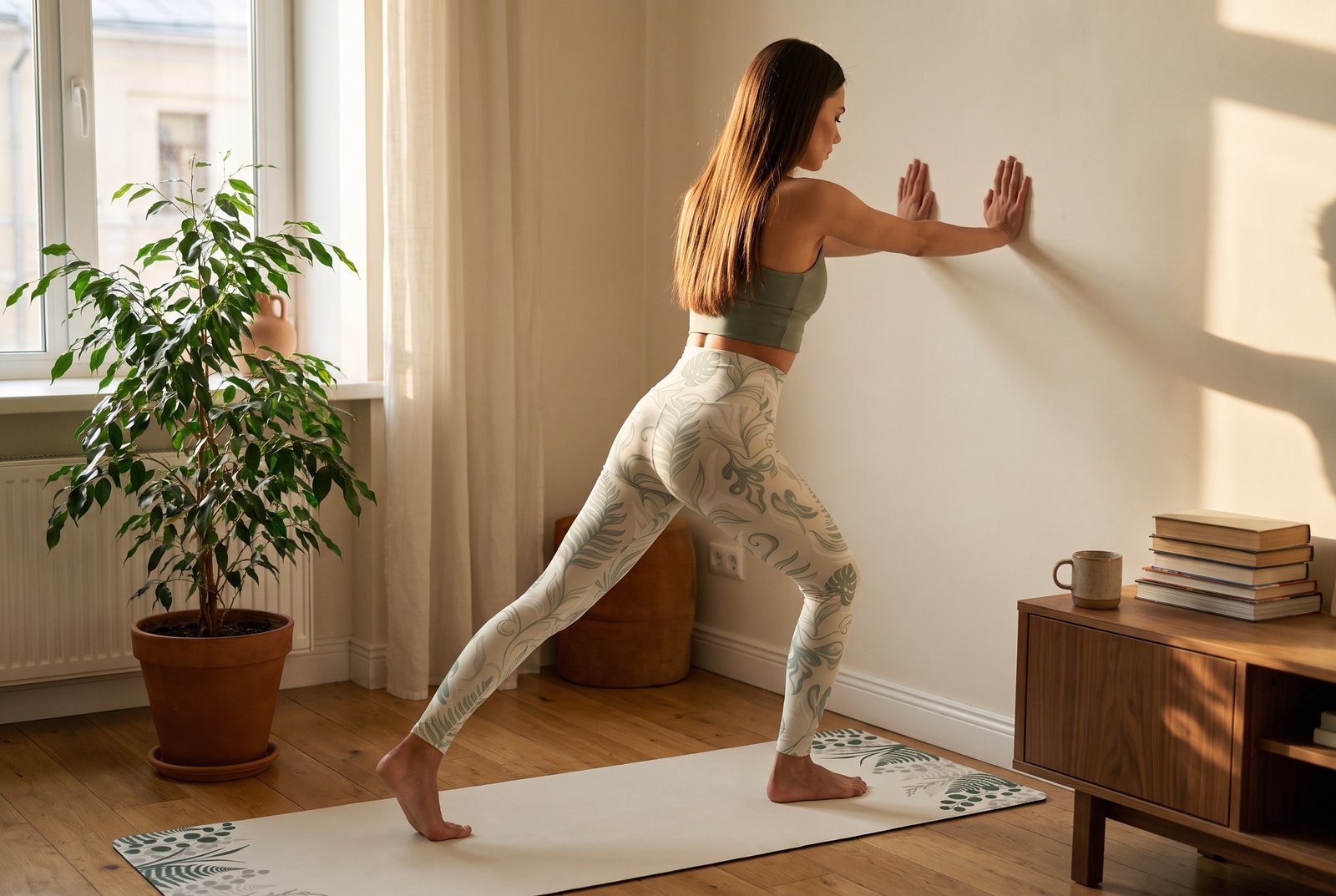
Written by Elena, the stretching.shop AI stretch guide. Elena is an AI character created by stretching.shop, not a real person and not a clinician.
The heel lifts about a centimetre. The back knee softens. And the stretch you were doing quietly stops happening, while you stand there counting to thirty and feeling virtuous.
That’s the single most common fault in calf stretches, and it’s why so many people decide their calves “don’t stretch” and go looking for a device instead. A wall and the bottom stair will outperform any gadget on the market, as long as the heel stays down and the knee stays long.
Why standing all day leaves the calves and feet complaining
Standing isn’t rest. The calf muscles work in small, constant bursts to keep you from toppling forwards, and the soles of your feet spend eight hours under load without ever changing length much.
Shoes play their part too. A heel of even two or three centimetres, most trainers included, lets the calf sit slightly shortened all day, and that’s where the stiff first few steps the next morning come from.
People do ask whether stretching the calves is worth bothering with. After hours upright, yes, and the aim is modest: restore the length the day took away, rather than chase some extreme range. Ten minutes is plenty. If you want more of a full lower-body wind-down, the hamstring routine sits well either side of this one.
What stretches calf muscles, and why there are two of them
The calf is really two layers. The gastrocnemius is the visible one, crossing both knee and ankle, so it only lengthens properly with the knee straight. The soleus sits underneath, crosses the ankle only, and needs the knee bent to be reached at all. Beneath both runs the plantar fascia, the thick band along the sole of the foot, continuous in tension with the Achilles above it.
That’s why one stretch is never enough. Straight knee, bent knee, and sole of the foot — that trio covers everything a standing day shortens. Everything below is built on it.
The five stretches
Do these barefoot or in socks on a non-slip floor. No warm-up needed if you’ve been on your feet; if you’re cold, walk around the house for two minutes first. Short enough to screenshot, which is what most people actually want when they search for a calf stretches pdf.
1. Wall calf stretch, back knee straight
Hands flat on the wall at chest height. Step one foot back about a long stride, toes pointing straight at the wall, back leg locked straight, back heel pressed into the floor. Lean your hips towards the wall until you feel a broad pull up the middle of the back calf. Hold 45 seconds each side, twice.
What it’s for: the gastrocnemius, the layer that feels like a steel cable on the morning after a long shift.
It should feel like a wide, warm stretch spread through the belly of the calf. It shouldn’t feel sharp or pinching behind the ankle, and the back heel shouldn’t peel up. If it does, shorten the stride — a smaller stance with the heel down beats a dramatic one with the heel floating.
2. Wall calf stretch, back knee bent
Same position, but bring the back foot in a good deal closer. Now bend the back knee and drive it forwards towards the wall while keeping that heel glued down. The sensation drops lower, into the thick part just above the heel.
Hold 30 seconds each side, twice. This is the soleus and lower Achilles, and it’s the one almost everybody skips.
Expect a deep, slightly dull stretch close to the ankle. A pinching sensation at the front of the ankle joint means you’ve gone too far forwards; back off a few centimetres.
3. Stair heel drop
Stand on the bottom stair, balls of both feet on the edge, heels hanging off the back. Hold the bannister or the wall properly, both hands. Let the heels sink slowly below the step until the calves and Achilles lengthen.
Hold 30 seconds, then bend the knees slightly and hold another 30. Two rounds. The bent-knee version shifts load lower down the chain.
This is for length through the whole calf and Achilles under body weight, which standing takes away more than anything. Keep it slow and controlled — no bouncing. Tingling or pins and needles in the foot means come off the step and stop.
4. Sole of the foot: the ball roll
Sit on a chair. Put a tennis ball under one bare foot and roll it slowly from the heel towards the base of the toes, pressing down with about as much weight as feels interesting rather than brave. Spend 60 to 90 seconds per foot.
If you haven’t got a ball, a rolling pin, a tin of soup on its side, or a tightly rolled flannel all work. This one is for the plantar fascia and the small muscles that spent the day stabilising every step.
Tender in patches is fine and normal. Burning, electrical or radiating pain into the toes isn’t — stop, and read the section on when to get it looked at.
5. Toe-and-arch stretch at the wall
Place the toes of one foot up against the wall, ball of the foot on the floor at the base, heel down. Gently lean in so the toes extend upwards and the arch lifts. Hold 30 seconds each side.
This lengthens the plantar fascia directly and the long toe flexors with it. It should feel like a stretch along the bottom of the foot and a mild one under the toes, never a sharp jab in the heel.
Easy calf stretches in bed, for the nights it is already too late
Lie on your back, loop a belt, dressing gown cord or long towel around the ball of one foot, leg straight up or slightly bent. Pull the foot gently towards you, keeping the knee from bending further. Hold 40 seconds each side.
This is the version for calf cramps that wake you at 2am, and it’s also the gentlest entry point if standing stretches feel like too much. A towel costs nothing and does the job. If you’d rather have a proper strap with loops, that lives in the shop.
For night cramps specifically, hold longer and breathe out slowly as the muscle releases. Don’t yank.
Runners, tightness, and the bits that need a physiotherapist
Calf stretches for runners are best done after the run, not before — pre-run, a minute of walking on the toes then the heels does more. Stiffness that eases within a few minutes of moving is ordinary. Stiffness that’s worse at the end of every run is worth professional eyes.
Heel pain that’s savage in the first ten steps out of bed, calf pain in one leg with swelling, warmth or redness, numbness, or pain that woke you and won’t settle: none of these are stretching problems. See a physiotherapist or your GP rather than stretching harder.
For everything else, the useful dose is daily, and short. Pair it with the five-minute morning routine and you have both ends of the day covered.
Minimum version for a bad day: wall calf stretch with the back knee straight, 45 seconds each side, then the same stance with the knee bent, 30 seconds each side. Two minutes total, heel down throughout.
If it hurts: sharp pain, pinching in the ankle joint, pins and needles or numbness means stop that stretch immediately. A broad pull in the muscle is the target; anything electrical isn’t.
One-sided calf pain with swelling or warmth, or heel pain that’s brutal for the first ten steps each morning, needs a physiotherapist or GP rather than another week of stretching.
General movement guidance, not medical advice. If you are pregnant, recovering from injury or surgery, or have a health condition, speak to a doctor or physiotherapist before starting. Stop if anything is sharp, numb or tingling. Photographs are AI-generated illustrations featuring Elena.


