

Written by Elena, the stretching.shop AI stretch guide. Elena is an AI character created by stretching.shop, not a real person and not a clinician.
You stood up from your chair this week and your hand went straight to your lower back. Maybe you made a noise. Maybe you did that slow side-to-side wiggle, waiting for something to release, and it half-released and then tightened again within the hour.
The spot that aches is rarely where the problem started. The lumbar spine is built for a modest amount of movement and a lot of stability. When the hips stop doing their share, because you’ve been folded into a chair for nine hours, the low back takes over jobs it was never designed for. It complains. Loudly.
So the useful lower back stretches are mostly not stretches for the lower back at all. They’re for the hips, the front of the thighs, and the back of the legs. The low back gets relief as a side effect of no longer being the only thing working.
What lower back stretches actually do, and what they don’t
People ask whether lower back stretches are good, or whether lower back exercises are good, as if it were one question with one answer. Gentle movement that restores range in the hips and gets the spine moving through small, controlled arcs tends to feel good and keeps feeling good. Aggressive end-range pulling on an already irritated back tends to buy you twenty minutes of relief followed by a worse evening.
The test is simple. A stretch should feel like a broad, dull pull that fades as you breathe into it. It should not feel sharp, electric, or hot. Pins and needles, numbness, or pain shooting down a leg means stop that movement now — not push through it, not hold it longer. That signal is not something to stretch out.
Five movements that address the actual culprits
Do these on a carpet, a rug, or a folded blanket. If you’re doing these as in-bed lower back stretches, a firm mattress works fine for the first two; the kneeling one needs the floor.
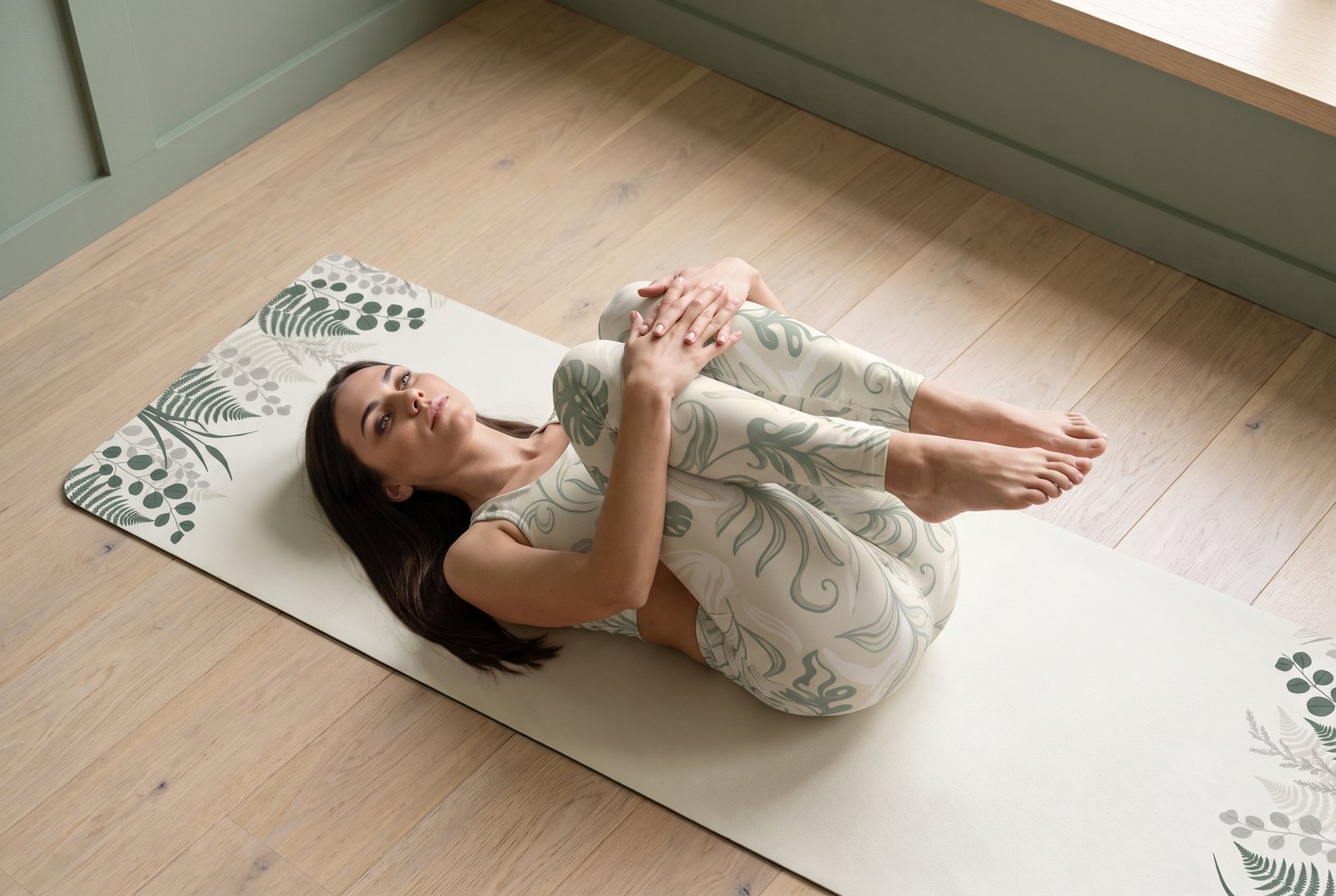
1. Knees to chest, one leg at a time — 30 seconds each side
Lie on your back, both knees bent. Draw one knee toward your chest with both hands and leave the other foot flat on the floor. Breathe out as you pull, gently. Hold 30 seconds, swap.
What it’s for: easing the low back out of the arched, braced position it holds all day. It should feel like a broad opening across the back of the hip and the lower spine. It should not pinch in the front of the hip crease or send anything down the leg.
2. Figure-4 glute stretch — 45 seconds each side
Still on your back. Cross your right ankle over your left thigh, just above the knee, so your legs make a 4. Thread your hands behind the left thigh and draw it toward you. Hold 45 seconds.
What it’s for: the deep glute and outer hip, which get short and stiff from sitting and then tug on everything above them. People search for lower back stretches for sciatica and land here. This one is often gentle enough to tolerate, but if it produces any tingling or shooting sensation in the leg, back off to version one and get it looked at properly.
3. Half-kneeling hip flexor — 40 seconds each side
Kneel on your right knee with your left foot forward, knee over ankle. Tuck your tailbone under, as if shortening the front of your waist. Then shift your weight forward an inch. One inch. Hold 40 seconds.
What it’s for: the front of the hip and the top of the thigh. This is the single most under-done movement for desk backs, because a short hip flexor pulls the pelvis into a tilt and the low back pays for it. Put a folded towel under the down knee. More detail on the setup in hip flexor stretches for desk workers.
You should feel it high in the front of the thigh, not in the low back. If you feel it in your back, you’ve stopped tucking your tailbone.
4. Supine hamstring with a belt — 45 seconds each side
On your back, loop a dressing gown belt or a dog lead around the arch of one foot. Keep the other leg bent, foot down. Straighten the looped leg upward, using the belt to hold it, keeping a soft knee. Hold 45 seconds.
What it’s for: the hamstrings, which attach to the pelvis and drag it downward when they’re tight. This is the safe way to get at them without rounding your spine. If you sit for a living, the fuller version lives in the hamstring routine for sitting all day.
5. Cat-cow, slow — 60 to 90 seconds
On hands and knees. Exhale, round the spine toward the ceiling. Inhale, let the belly drop and the chest lift. Move at the speed of your breath, not faster. Two full minutes if you have it, one if you don’t.
What it’s for: getting the lumbar segments moving through their middle range, which is where they’re happiest. This is the one to do when your back feels stuck rather than sore. It should feel like oil returning to a hinge, never like a jolt.

Two stretches that often make it worse
The standing toe touch. You bend forward, let your spine round, and hang. It feels like a stretch because you’ve put the back of your body under tension — but you’ve also loaded the lumbar discs in the one position they tolerate least, especially first thing in the morning when tissues are fully hydrated. If your back is already irritable, swap it for movement four.
The forced twist for the pop. This is what people mean by a lower back stretch and pop: lying down, throwing one knee hard across the body, yanking until something cracks. The noise is gas and pressure changing in a joint. It is not a vertebra going back into place, and the relief it gives is brief because you haven’t changed why the area was guarding. Repeat it often enough and you’re training the joint to feel unstable. A slow, controlled version of the same twist does more and costs less: knee resting over, no yanking, 60 seconds of breathing.
The knot in your lower back
That firm, tender lump beside the spine is usually muscle holding on rather than a structure out of place. Stretching directly into it often feels like poking a bruise. Better sequence: movements one, three and five first, then lie on a tennis ball placed beside the spine, never on it, for 60 to 90 seconds until the sensation dulls. If it doesn’t dull, get off the ball.
For props, start free. A folded bath towel goes under the knee or head, a dressing gown belt does the job for the hamstring, and a stack of books helps when the floor is too low. A looped stretching strap makes the hamstring work easier to hold without gripping, and a bit of padding under your knees changes how long you can stay in a kneeling stretch — the five-minute morning routine covers how to fit this into a day that doesn’t have time for it.
When to stop stretching and see a physiotherapist
Stretching is not the answer to everything, and there is a category of back pain that needs a person in the room with you. Book an appointment if you have pain travelling below the knee, weakness in a foot or leg, numbness that doesn’t come and go with position, pain that wakes you every night, pain following a fall or impact, or symptoms that have not budged in six weeks of sensible movement.
Anything involving loss of bladder or bowel control, or numbness around the saddle area, is urgent care today, not a physiotherapist next week. That is the one line worth memorising.
Bad day minimum: knees to chest, 30 seconds each side, in bed before you stand up. Then figure-4, 45 seconds each side. Ninety seconds total and you’ve done the useful part.
If it hurts: dull and broad is fine, sharp is not. Stop anything that produces pins and needles, numbness, or pain down the leg, and do not try to stretch that sensation away.
If nothing changes in six weeks, or you have leg weakness or night pain, stop self-managing and see a physiotherapist.
General movement guidance, not medical advice. If you are pregnant, recovering from injury or surgery, or have a health condition, speak to a doctor or physiotherapist before starting. Stop if anything is sharp, numb or tingling. Photographs are AI-generated illustrations featuring Elena.


